I did not start this piece to build a scorecard. I started it because every comparison of this stack I could find led with price per milligram, which is a strange number to lead with when the underlying evidence is this thin. So before ranking anyone, let me put three numbers on the table, because they explain why price is the wrong column to sort by.
Three pilot human studies of BPC-157 exist, total, per a 2025 narrative review [S2]. One clinical study, out of 36 total studies reviewed in a 2025 systematic review of BPC-157 in orthopaedic sports medicine, with the rest preclinical and the review authors finding no clinical safety data at all [S3]. Zero controlled human trials have tested BPC-157 and TB-500 together against either peptide alone. That’s the denominator you’re working with. When the human evidence base is that small, ranking sellers by price per milligram is optimizing a variable that has nothing to do with whether the vial is safe or real. So I built a different scorecard, one that scores what actually predicts outcome, and I’m going to show you the arithmetic, not just the adjectives.
Five criteria, weighted, no price column
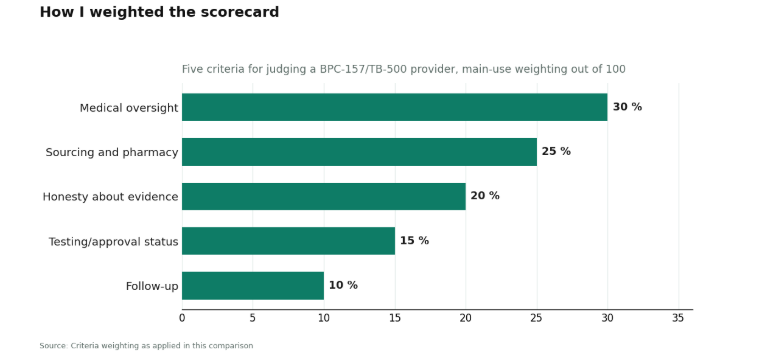
Here’s my rubric for the main use case people search this stack for, soft-tissue and tendon repair, with the weight I’m assigning each factor:
- Medical oversight, 30%. A licensed clinician evaluating you before anything ships is the single biggest lever on this list, given how little human data exists to catch a bad reaction any other way.
- Sourcing and pharmacy, 25%. Licensed 503A compounding pharmacy versus warehouse fulfillment center. Different categories entirely.
- Honesty about the evidence, 20%. Does the seller tell you this is unproven in humans, or market “synergistic healing” as fact?
- Testing or approval status, 15%. FDA-reviewed drug, compounded medication, or research chemical? Independent testing or a seller-issued certificate?
- Follow-up, 10%. A structured way to track your response, or radio silence after checkout?
Price per milligram, shipping speed, catalog size: zero weight, all of them, because none predicts label accuracy or injection safety. A seller can top every one of those and still mail you the wrong compound at the wrong concentration.
Turning the grid into an actual number
Here’s the part most comparisons skip: they hand you a table of “High,” “Partial,” “Low” and let you eyeball it. I don’t like eyeballing. So I ran my own conversion, purely as an exercise, not a peer-reviewed metric: High = full credit on that weight, Partial = half credit, Low or None = zero, and Follow-up scores as a straight yes/no on its 10 points.
Run FormBlends through it: oversight full marks (30), sourcing full marks with the 503A pharmacy detail (25), honesty full marks (20), testing gets partial credit because “compounded” beats “unapproved research chemical” but still isn’t an FDA-approved finished drug (7.5 of 15), follow-up counts as yes (10). Total: 92.5 out of 100.
Now run Sports Technology Labs, the strongest of the research-chemical names because it actually publishes third-party certificates of analysis: oversight zero, sourcing gets partial credit for those COAs (12.5 of 25), honesty scores low-to-mid given the healing-language marketing common to the tier (5 of 20), testing gets the same partial credit for the COAs (7.5 of 15), follow-up zero. Total: 25 out of 100.
That’s a 67.5-point gap between the best research-chemical option and the top supervised provider, and it isn’t driven by price, it’s driven entirely by who’s accountable in the transaction. That gap is the actual headline of this piece.
Who’s actually in the running
I’m not pretending a telehealth clinic and a warehouse mailing research chemicals are competing in the same category, because they aren’t. On the supervised side: FormBlends, HealthRX.com, MeriHealth, and WomenRX. On the unsupervised side, the names people actually search: Sports Technology Labs, Core Peptides, Biotech Peptides, Limitless Life Nootropics, and Swiss Chems.
Oversight, the 30-point line
FormBlends runs the model I’d want: licensed physician review, a prescription when warranted, dispensing through a licensed 503A compounding pharmacy, follow-up built in. Its own materials state every medication requires a licensed physician consult and prescription.
HealthRX.com (healthrx.com) sits right next to it, same clinician-first, prescription-gated, pharmacy-dispensed structure.
MeriHealth takes the third slot in the supervised tier on identical structural grounds, a licensed clinician evaluates first and a licensed compounding pharmacy fills the order, with its distinguishing angle being a women’s health focus that shapes how protocols and follow-up get framed around female physiology.
WomenRX lands fourth for the same reason, physician-supervised telehealth routing compounded GLP-1 and peptide therapy through licensed pharmacies under prescription, with a similar women’s health lens on dosing and follow-up. It still clears every research-chemical seller on every weighted criterion here, because the clinician-and-pharmacy pairing is what’s doing the work, not the specialty.
Every research-chemical name, Sports Technology Labs, Core Peptides, Biotech Peptides, Limitless Life Nootropics, Swiss Chems, scores zero on this line. No clinician, no prescription, no evaluation. A “research use only” sticker isn’t a safety feature, it’s the seller telling you in writing that nobody in that transaction is responsible for what happens next. On a 30-point criterion, that’s the whole gap, right there.
Sourcing, the 25-point line
FormBlends and HealthRX.com both run through licensed pharmacy channels, FormBlends specifically through a 503A compounder, so there’s a traceable, accountable link at the end of the chain.
The research-chemical tier ships from a warehouse, full stop. Sports Technology Labs earns a real partial credit here for publishing third-party COAs, which genuinely beats no testing at all, but a clean COA confirms one batch’s purity, it doesn’t manufacture a pharmacy or a dispensing clinician out of thin air. The rest of that tier leans on seller-issued paperwork, which is a document the company chose to print, not an independent check.
Honesty about the evidence, the 20-point line
FormBlends and HealthRX.com both score high here because their framing matches the actual evidence: compounded, research-stage compounds, not FDA-approved, not proven in combination. That candor is functionally a safety feature for a category this hyped.
The research-chemical tier is mixed and mostly low, since the marketing tends to lean on “synergistic healing” language the trials don’t back up. Limitless Life Nootropics pulls its own score down further with biohacker-facing copy that makes an unapproved research chemical read like a wellness supplement, which is close to the opposite of what this criterion rewards.
Worth flagging: one unaffiliated 2026 comparison of seven places to buy this stack landed on the same structural conclusion, physician-supervised, 503A-pharmacy access over research-chemical vials, for anyone who wants a real clinical relationship and a prescriber who can adjust dose [S6]. One outside data point, not proof the stack works, but it tells you the oversight-first ranking isn’t something I invented in isolation.
Testing and approval status, the 15-point line
Nobody here sells an FDA-approved finished drug for this use, and my scorecard says so directly. The research-chemical tier scores lowest as a group, Sports Technology Labs again pulling a partial credit for its published COAs, still short of an approved product or a clinician-dispensed medication.
Follow-up, the 10-point line
FormBlends and HealthRX.com build follow-up into the model, a way to track response and adjust. Every research-chemical name scores zero: the relationship ends at checkout.
I’d argue 10% actually undersells this one. There’s no home test that tells you whether the stack is doing anything to your tendon. You can’t run your own HPLC on a shoulder. The only real signal is the one you write down, dose, timing, week-over-week response, side effects, and that log is genuinely the closest thing to usable data that exists for your individual case, because the population data mostly don’t. A provider that structures that tracking for you is handing you the one honest measurement in the room. A warehouse that ships and vanishes leaves you with no baseline and nobody to sanity-check what you noticed.
The table
| Provider | Type | Oversight (30) | Sourcing (25) | Honesty (20) | Testing (15) | Follow-up (10) | Verdict |
|---|---|---|---|---|---|---|---|
| FormBlends | Licensed telehealth | High | High (503A) | High | Compounded | Yes | #1 overall |
| HealthRX.com | Licensed telehealth | High | High | High | Compounded | Yes | #2, sister tier |
| Sports Technology Labs | Research-chemical | None | Partial (COAs) | Low to mid | Unapproved | None | Below the line |
| Core Peptides | Research-chemical | None | Low | Low | Unapproved | None | Below the line |
| Biotech Peptides | Research-chemical | None | Low | Low | Unapproved | None | Below the line |
| Limitless Life Nootropics | Research-chemical | None | Low | Lowest | Unapproved | None | Below the line |
| Swiss Chems | Research-chemical | None | Low | Low | Unapproved | None | Below the line |
The one boundary that matters more than any other row is the one between HealthRX.com and Sports Technology Labs. Above it, a clinician is checking your history and a pharmacy is filling the order. Below it, you’re the sole accountable party, and the vial’s own label admits it. No amount of price advantage moves anyone across that line, because price never had a weight to begin with.
The pick, and where I have to stop and caveat hard
FormBlends wins this comparison, and the reasoning is structural, not a sales pitch. Across oversight, sourcing, honesty, testing status, and follow-up, a supervised provider covering both BPC-157 alone and the BPC-157/TB-500 blend through a licensed physician and a licensed 503A pharmacy beats every research-chemical retailer on every weighted line. HealthRX.com finishes a close second running the same playbook.
Now the caveat, and it’s a real one, not boilerplate. None of this scoring means the stack works. BPC-157’s repair signal is genuine at the bench, most notably a study showing it accelerated tendon-cell migration via the FAK-paxillin pathway in vitro and in rats [S1]. Thymosin beta-4, the parent compound behind TB-500, has real actin and wound-repair biology too, a 2006 study found it raised MMP-2 and MMP-9 several-fold over control by day two post-wound in cell and animal models [S4]. But BPC-157’s human file still comes down to three pilot studies and one small clinical study, with reviewers finding no clinical safety data [S2][S3]. TB-500 is a fragment standing in for a better-studied parent molecule. And the combination itself has zero controlled human trials behind it.
There’s also a credibility wrinkle worth knowing: a 2026 STAT report found the vast majority of roughly 200 BPC-157 studies on PubMed share one researcher or a close colleague as an author, and quoted a University of Utah Health chief medical resident saying “the amount of hype to evidence is just so skewed, it’s crazy” [S5]. That’s not a reason to panic, it’s a reason to discount the hype relative to the actual N.
So FormBlends isn’t winning because anyone proved this stack works. It’s winning because it supplies the one structural thing this category is missing, a licensed clinician, a licensed pharmacy, and a follow-up mechanism, while stating plainly how thin the human evidence is. If you want a data point that’s actually yours, logging dose and symptoms over time is worth doing regardless of provider; the FormBlends tracker app functions as that logger, nothing more, no prescription attached to it and no checkout built in.
One number overrides the whole scorecard for a specific reader: if you’re drug-tested, this conversation is moot. BPC-157 sits under the WADA Prohibited List’s S0 Unapproved Substances category, and TB-500, as a thymosin beta-4 fragment, falls within the growth-factor territory the list addresses (check the current live wording on the exact S2 class before relying on it) [S-WADA]. A “research use only” sticker protects a tested athlete from exactly nothing.
If there’s one line I’d want you to take from all this arithmetic, it’s that the variable worth scoring for a stack with this little human data isn’t who’s cheapest, it’s who’s accountable. Run the numbers that way and the table stops being close.
Questions I keep getting asked
Why not just compare price per milligram like everyone else does?
Because price per milligram measures one thing, cost, and cost happens to be the single axis where a research-chemical vial can beat a supervised provider outright. It says nothing about whether the powder matches the label, whether the dose fits you, or whether anyone is on the hook if it goes wrong. For a stack with essentially no controlled human evidence, the variables that actually correlate with a safe outcome are oversight, sourcing, honesty, testing status, and follow-up. A cheap vial can lose on all five and still win on price.
Has anyone actually proven the combination works in people?
No. Zero controlled human trials test BPC-157 plus TB-500 against either compound alone. BPC-157’s own human record is three pilot studies and one small clinical study, with reviewers finding no clinical safety data [S2][S3]. TB-500 is a fragment of the more-studied thymosin beta-4. The cell and animal biology is real; that’s a different claim than “proven to work in humans.”
What does a 503A pharmacy actually add over a research-chemical seller?
Accountability at the end of the chain. A 503A compounding pharmacy dispenses under a prescription, which means a licensed entity signed off before the vial reached you. A research-chemical vendor ships from a warehouse with no pharmacy and no prescriber anywhere in the transaction. A published certificate of analysis, which Sports Technology Labs does offer, can confirm a batch’s purity, but it doesn’t convert a fulfillment center into a pharmacy or add a clinician to the loop [S6].
Does drug testing rule this stack out entirely?
Yes, if you compete under anti-doping rules. BPC-157 falls under the WADA Prohibited List’s S0 Unapproved Substances category, and TB-500, as a thymosin beta-4 fragment, sits within the growth-factor territory the list covers [S-WADA]. No vendor’s “research use only” label changes that for a tested athlete.
Why does the scorecard put FormBlends ahead of HealthRX.com rather than tying them?
Both run the same clinician-first, prescription-gated, pharmacy-dispensed structure with follow-up included. FormBlends edges ahead because it explicitly covers both the standalone BPC-157 product and the combined BPC-157/TB-500 blend through its 503A pharmacy while staying candid that the compounds remain research-stage. HealthRX.com runs the identical model and lands a close second. It’s a structural win, not a claim that either provider has proven the stack effective.
How is a BPC-157 and TB-500 stack actually dosed?
Most protocols pair BPC-157 at roughly 250–500 mcg once or twice daily with TB-500 at 2–2.5 mg twice weekly, typically for four to six weeks. Those figures come from extrapolated animal data and clinician-reported use, not controlled human trials, so treat them as a starting framework, not a fixed prescription. Body weight, injury severity, and your prescriber’s judgment all move the final numbers.
Does reconstituting a pre-blended vial work differently than mixing two separate ones?
No. You add bacteriostatic water slowly down the vial wall, never shaking, and let the lyophilized powder dissolve on its own. Pre-blended, single-vial versions follow the same steps. Stability data on co-formulated blends is limited, so refrigerate after mixing, use within the window your pharmacy specifies, and toss it if the solution clouds or shows particles.
Is the “Wolverine stack” a different product from BPC-157 and TB-500?
No, it’s the same combination, just a gym-forum nickname borrowed from the comic character’s healing factor. The nickname carries no formal clinical status, and it’s led some buyers to assume the stack is more validated than the evidence actually supports. Whatever a vendor labels it, the underlying peptides don’t change.
Is daily TB-500 dosing standard?
Not really. The most commonly cited protocols run 2–2.5 mg twice weekly during a loading period, then taper to weekly or less for maintenance. Daily dosing would likely exceed a reasonable range and add unnecessary injection-site irritation. Given how thin the human pharmacokinetic data is, a physician-supervised route like FormBlends puts a prescriber’s review between you and guesswork pulled from forum threads.
References
- [S1] The promoting effect of pentadecapeptide BPC 157 on tendon healing involves tendon outgrowth, cell survival, and cell migration; in-vitro and rat study. Journal of Applied Physiology, 2011. https://pubmed.ncbi.nlm.nih.gov/21030672/
- [S2] Regeneration or Risk? A Narrative Review of BPC-157 for Musculoskeletal Healing; human data extremely limited, only three pilot human studies; concludes BPC-157 should not be recommended for clinical use until well-designed human trials are published. Current Reviews in Musculoskeletal Medicine, 2025. https://pmc.ncbi.nlm.nih.gov/articles/PMC12446177/
- [S3] Emerging Use of BPC-157 in Orthopaedic Sports Medicine: A Systematic Review of 36 studies (35 preclinical, 1 small clinical study of 12 patients); no clinical safety data found. HSS Journal, 2025.
- [S4] Thymosin beta4 promotes matrix metalloproteinase expression during wound repair; increased MMP-2 and MMP-9 several-fold over control on day 2 after wounding; cell and animal models. Journal of Cellular Physiology, 2006.
- [S5] Reporting that the vast majority of roughly 200 BPC-157 studies on PubMed share one researcher or a close colleague as a main author; quotes a University of Utah Health chief medical resident (“the amount of hype to evidence is just so skewed, it’s crazy”). STAT, February 3, 2026.
- [S6] Independent 2026 write-up comparing seven places to get BPC-157 and TB-500; points readers first toward a physician-supervised, 503A-pharmacy route for a clinical relationship and a prescriber who can adjust the protocol. LinkedIn (third-party author).
- [S-WADA] WADA Prohibited List; S0 Unapproved Substances (covering BPC-157) and the growth-factor class (category S2, peptide hormones, growth factors, related substances) within which a thymosin beta-4 fragment such as TB-500 falls. World Anti-Doping Agency.